Quick answer
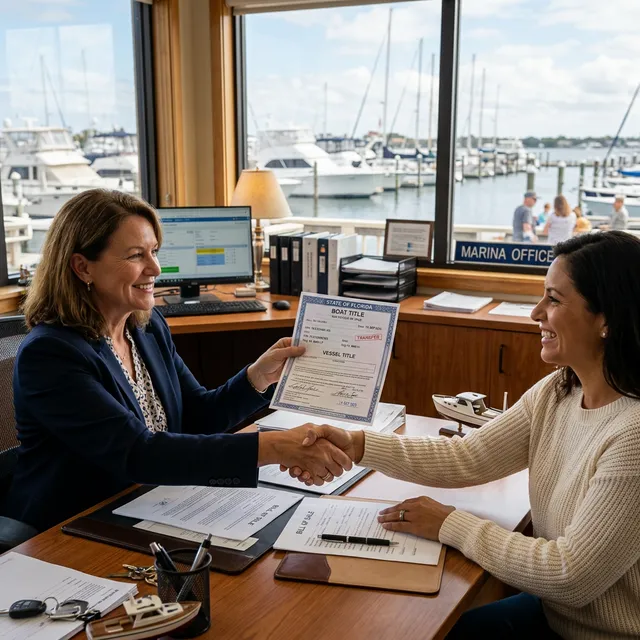
To transfer a boat title, the seller signs the existing title, both parties complete a bill of sale, and the buyer files a state title application with fees and any sales or use tax. In this site's 2026 state data, 42 states require a boat title and 8 states use registration or other ownership documents instead.
Always verify the final form, tax, and filing deadline with the state agency that issued the title.
How to Transfer Boat Title and Ownership
Transferring the title of a boat is a critical step in the vessel buying and selling process. In states that issue vessel titles, a title transfer changes the legal ownership record from the seller to the buyer. Without the right ownership paperwork, the buyer may be unable to register the boat, obtain insurance, or prove ownership in case of disputes.
The transfer process varies by state, but the fundamental steps are consistent across the country. This guide walks you through each step, common pitfalls to avoid, and important considerations for both buyers and sellers.
Step-by-Step Title Transfer Process
Step 1: Verify the Current Title
Before completing any boat purchase, verify that the seller has a valid, original title in their name. The title should be free of liens and encumbrances, and the Hull Identification Number (HIN) on the title must match the HIN physically stamped on the vessel's transom.
Red flags to watch for: titles in a name other than the seller, "duplicate" or "bonded" titles, titles from states different than where the boat is currently registered, and any signs of alteration. If anything seems off, request a lien search and consider having the HIN verified by law enforcement before proceeding.
Step 2: Complete a Bill of Sale
A Bill of Sale is a legal document that records the terms of the sale. While some states do not technically require a Bill of Sale, it is strongly recommended for every transaction as it protects both parties. A thorough Bill of Sale should include:
- Full legal names and addresses of both buyer and seller
- Hull Identification Number (HIN)
- Vessel make, model, year, and length
- Engine make, model, and serial number(s)
- Sale price (even if $0 for a gift transfer)
- Date of sale
- Signatures of both parties
- Notarization (required by some states)
Step 3: Seller Endorses the Title
The seller must sign the back of the title in the designated area (often labeled "Assignment of Title"). In some states, the seller must also provide their current address and the date of transfer on the title. The seller's signature must match the name printed on the front of the title.
If the vessel is jointly owned (two names on the title), the requirements for signatures depend on whether the names are connected by "and" (both must sign) or "or" (either can sign). Know the rules in your state to avoid delays.
Step 4: Submit Application for New Title
The buyer submits the following documents to the appropriate state agency (typically the DMV, Department of Natural Resources, or Fish and Wildlife Department):
- The original title signed by the seller
- Completed title application form (state-specific)
- Bill of Sale
- Valid photo identification
- Title transfer fee payment
- Sales or use tax payment based on the purchase price
- Registration application and fee (if registering simultaneously)
Step 5: Receive New Title
After processing the application, the state will issue a new title in the buyer's name. Processing time varies by state, county office, title option, and whether the paperwork is complete. Some states provide a temporary registration or receipt that allows you to operate the vessel while the permanent title is being processed.
Title vs. Registration: Understanding the Difference
A boat title and boat registration serve fundamentally different purposes, yet many boat owners confuse the two. A title is a legal document that proves ownership of the vessel — much like a car title. A registration, on the other hand, grants permission to operate the vessel on public waterways and assigns a registration number that must be displayed on the hull.
Think of it this way: you own the boat because of the title, and you have permission to use it because of the registration. When you sell a boat, you transfer the title to prove the new owner's right to the vessel. The registration is then obtained by the new owner separately.
For a deeper comparison, see our Title vs. Registration Guide.
Which States Require Boat Titles?
In the current BoatRegistrationUSA state dataset, 42 states require some form of boat title, while 8 states rely on registration records, bills of sale, or other ownership documents instead. The specific requirements vary:
- All motorized vessels: Most title states require titles for all vessels with engines, regardless of size.
- Length-based thresholds: Some states only require titles for vessels above a certain length (e.g., 14 ft or 16 ft).
- Horsepower-based thresholds: A few states tie title requirements to engine horsepower (e.g., 25 HP or more).
- No title requirement: Arizona, Colorado, Delaware, Kansas, Mississippi, New Hampshire, North Dakota, Tennessee do not require a separate boat title in the current state data.
Use our Title Requirements Checker to instantly determine whether your state requires a title for your specific vessel.
Seller Responsibilities Checklist
As a seller, you have several obligations to ensure a smooth and legal title transfer:
- Provide the original title: Ensure the title is in your name, free of liens, and undamaged. If lost, apply for a duplicate title before listing the boat for sale.
- Sign the title properly: Sign in the designated "Assignment of Title" area. Your signature must match the name on the title exactly.
- Complete a Bill of Sale: Provide the buyer with a signed Bill of Sale that includes all vessel details, sale price, and date.
- Satisfy all liens: Pay off any outstanding loans and obtain a lien release from the lender.
- Notify your state agency: Some states require sellers to notify the registration agency of the sale within a specified timeframe (typically 10-30 days).
- Cancel your registration: Cancel or surrender your existing registration to avoid future liability.
- Provide maintenance records: While not legally required, providing service records adds value and builds buyer confidence.
Buyer Responsibilities Checklist
As a buyer, protect yourself by completing these steps during and after the purchase:
- Verify the title: Confirm the seller's name matches the title, the HIN matches the vessel, and there are no signs of alteration.
- Run a lien check: Contact the state title agency or USCG to verify no outstanding liens exist. See our Boat Lien Check Guide.
- Inspect the HIN: Physically verify that the Hull Identification Number on the transom matches the title and Bill of Sale.
- Secure a Bill of Sale: Ensure it contains all required details (names, addresses, HIN, sale price, signatures).
- Submit title application promptly: Apply for a new title in your name within the state-required timeframe (typically 15-30 days).
- Pay all fees and taxes: Title transfer fee, registration fee, and sales/use tax.
- Register the vessel: Most states allow simultaneous title transfer and registration, streamlining the process.
- Obtain insurance: Secure boat insurance before operating the vessel, especially if it is financed.
Title Transfer Costs
The total cost of a title transfer includes several components:
- Title transfer fee: $2.25 to $75.00 in this site's current title-required state data where a numeric transfer fee is listed
- Registration fee: Varies by state and vessel size (if registering simultaneously)
- Sales or use tax: Based on the purchase price or fair market value at the state's applicable rate
- Lien recording fee: $5-$15 if the vessel is financed
- Notarization fee: $5-$15 if required by the state
Use our Boat Registration Fee Calculator to estimate the total cost for your specific state and vessel.
State Title Transfer Fees Comparison
Title transfer fees vary by state. The following table shows the title fee and transfer fee for states that require boat titles. States that do not require titles are excluded.
| State | New Title Fee | Transfer Fee | Sales Tax Rate |
|---|---|---|---|
| Alabama | $20; county or designated-agent commission may also apply | $20; county or designated-agent commission may also apply | 4% state sales tax; local tax and county charges may also apply |
| Alaska | $20.00 | DMV lists $20 for a boat title or duplicate title; confirm any ownership-transfer filing charges before submitting Form B1 | No statewide sales tax; local municipal taxes may apply |
| Arkansas | $10.00 | $10.00 | Sales tax is collected when due; Arkansas does not charge sales tax on casual individual-to-individual boat sales |
| California | DMV transaction-specific | $15.00 vessel transfer fee | 7.25% statewide base plus applicable local district tax/use tax |
| Connecticut | $25.00 | $25.00 | 2.99% for vessels/trailers purchased on or after July 1, 2018; 6.35% for earlier purchase dates |
| Florida | $5.25 for standard title transactions; fast title or county service charges may differ | $5.25 standard title transfer fee before any fast-title, lien, county, or service charges | 6% state sales/use tax base; county surtax, exemptions, and proof-of-tax rules may also apply |
| Georgia | No separate eTitle fee listed; optional paper title fee is $10 | No separate eTitle transfer fee listed; transfer depends on the registration record, bill of sale, and any existing paper title | 4% state sales/use tax base; local rates, exemptions, and proof-of-tax rules may also apply |
| Hawaii | $20.00 | $30.00 | DOBOR fees are separate from Hawaii GET/use-tax treatment, which can depend on the transaction and county surcharge |
| Idaho | $14.00 | $14.00 | 6% state sales/use tax base; local-option tax or exemptions may affect the final transaction |
| Illinois | $0.00 | $0.00 | 6.25% state use/sales tax base; local tax and RUT/ST forms depend on the purchase |
| Indiana | $15.00 | $15.00 | 7% state sales/use tax base when due; BMV excise tax and DNR/lake permit charges are separate |
| Iowa | $13.50 | $13.50 | 6% state sales/use tax base; local tax or proof-of-tax treatment may affect the final county recorder total |
| Kentucky | $9.00 | $9.00 | 6% state sales/use tax base when due; county property tax, title, lien, and clerk charges are separate |
| Louisiana | $15.00 | $15.00 | Louisiana state sales/use tax base plus local tax or R-1331 proof rules when due |
| Maine | $33.00 | $33.00 | 5.5% state sales/use tax base when due; municipal excise tax and Lake and River Protection sticker treatment can change the filing total |
| Maryland | $20 title fee before lien, replacement, documented-vessel, or service-center charges | $20 standard title transfer fee before lien, excise-tax, or service-center charges | 5% Maryland vessel excise tax when due; exemptions, credits, documented-vessel treatment, and any statutory cap should be confirmed with DNR |
| Massachusetts | $27.50 title fee when a title is required | $27.50 title transaction fee before lien or document-specific charges | 6.25% Massachusetts sales/use tax when due; proof-of-tax or exemption documents may be required |
| Michigan | $5.00 | $5.00 | 6% |
| Minnesota | $15 title fee before issuing, lien, transfer, or duplicate charges | $10 title transfer fee before issuing, lien, or duplicate charges | 6.875% state sales/use tax base; local tax, title, lien, and transfer charges may also apply |
| Missouri | $7.50 boat title fee before outboard motor title, lien, processing, or local-office charges | $7.50 title transfer fee before outboard motor title, lien, processing, or local-office charges | 4.225% state sales/use tax base plus applicable local tax when due; personal property tax is separate |
| Montana | $10.00 | $10.00 | 0% |
| Nebraska | $10 title fee before lien, county, or transaction-specific charges | $10 title transfer fee before lien, county, or transaction-specific charges | 5.5% state sales/use tax base when due; local tax, title, lien, and county transaction charges may also apply |
| Nevada | $20.00 | $20.00 | Sales/use tax proof is required when applicable; NDOW states occasional sales are not required |
| New Jersey | $60 title fee; MVC lists a higher title fee when a lien is recorded | $60.00 | 6.625% New Jersey sales/use tax may apply to boat purchases; confirm required tax proof with MVC when titling or registering |
| New Mexico | Confirm the current MVD title fee at filing | $15.00 | 5% boat excise tax may apply when a boat required to be registered is titled; confirm value, exemptions, and filing details with MVD |
| New York | $50.00 | $50.00 | 4% New York state sales/use tax plus applicable local tax may apply; confirm tax proof and local rate with DMV or the Tax Department |
| North Carolina | $36.00 | $36.00 | Taxes or highway-use tax, if due, are handled outside the NCWRC vessel fee table; confirm with NCWRC or NCDMV before filing |
| Ohio | $15 Ohio watercraft title fee before any county or Clerk of Courts charges | $15.00 | 5.75% Ohio state sales/use tax plus applicable local tax may apply; confirm tax proof with the Clerk of Courts or filing office |
| Oklahoma | Confirm current Oklahoma title and record fees at filing | $2.25 | Oklahoma boat excise tax and registration fees are based on the state fee schedule, not a flat sales-tax estimate; confirm the final amount with Service Oklahoma |
| Oregon | $75.00 | $75.00 | No Oregon state sales tax, but OSMB title, registration, AIS, and waterway access permit fees can still apply |
| Pennsylvania | $30.00 | $30.00 | 6% Pennsylvania sales/use tax may apply, with local surtax in some jurisdictions; confirm tax proof before filing |
| Rhode Island | $25.00 | $5.00 | No Rhode Island state sales tax on qualifying boat purchases; confirm documentation and any non-tax fees with DEM |
| South Carolina | $10.00 | $20.00 | 5% |
| South Dakota | $10 title fee; liens and other DOR/County Treasurer fees can add charges | $10.00 | 4.5% South Dakota sales/use tax may apply; confirm local, county treasurer, and filing-specific charges before payment |
| Texas | $27.00 | $27.00 | 6.25% sales/use tax; TPWD lists an $18,750 cap for vessels and outboard motors purchased in Texas on or after September 1, 2019 |
| Utah | $6.00 | $6.00 | Sales/use tax varies by registration locality |
| Vermont | Agency-specific for titleable vessels; confirm current title transaction fee with Vermont DMV | Confirm current title-transfer fee with Vermont DMV | 6% |
| Virginia | $10 title fee; duplicate, lien, or title-change items can add separate DWR fees | $10.00 | 2% Virginia Watercraft Sales Tax on watercraft and motor, capped at $2,000; confirm credit and taxable value with DWR |
| Washington | Confirm current DOL title and filing fees at licensing | $5.00 | 6.5% Washington state sales/use tax plus local tax may apply; annual watercraft excise tax and DOL filing fees can also apply |
| West Virginia | Confirm the current DMV motorboat title fee at filing | $5.00 | 6% West Virginia sales/use tax may apply; personal property tax proof and DMV title/registration fees can also affect filing |
| Wisconsin | $5 title fee; lien, transfer, duplicate, or other DNR fees can apply | $5.00 | 5% Wisconsin state sales tax plus applicable county or city sales tax may apply unless an exemption applies |
| Wyoming | Confirm county clerk title, lien, and tax-proof fees before filing | $15.00 | Wyoming state and local sales/use tax proof may be required before county title and WGFD registration are complete |
For a complete breakdown of registration fees (separate from title fees), see our 50-State Cost Comparison.
Common Pitfalls and How to Avoid Them
Buying a Boat Without a Title
In states that require titles, purchasing a vessel without a title is extremely risky. Without a title or a state-approved replacement path, you may be unable to register the boat, prove ownership, or obtain insurance. The seller may not have legal authority to sell the vessel, or the vessel may have outstanding liens. Ask the seller to obtain a duplicate title or confirm the state-approved missing-title process before you complete the purchase.
Undisclosed Liens
A lien is a legal claim against the vessel, usually from a lender who financed the purchase. If the seller still owes money on the boat, the lien must be satisfied (paid off) before or at the time of sale. The lienholder should provide a lien release, which you will need for the title transfer. Always run a lien check before completing the purchase — see our Boat Lien Check Guide.
Inherited Boats
If you inherited a boat, the title transfer process requires additional documentation such as a death certificate, letters testamentary or letters of administration from the probate court, and possibly an affidavit of heirship. Contact your state agency for the specific requirements, as probate and inheritance rules vary significantly by state.
Gifted Boats
When a boat is gifted (no money changes hands), you still need to complete a title transfer. The Bill of Sale should list the sale price as "$0" or "gift." Most states will assess sales tax based on the fair market value of the vessel rather than the stated price, but some states offer a gift exemption from sales tax when transferring between immediate family members.
States Without Title Requirements
In the current 50-state dataset, 8 states do not list a separate boat title requirement: Arizona, Colorado, Delaware, Kansas, Mississippi, New Hampshire, North Dakota, Tennessee. In these states, the agency may rely on registration records, bills of sale, prior paperwork, or other ownership documents. While this can simplify the filing path, it can make ownership verification more difficult for buyers, so a complete bill of sale and clear chain of ownership become more important.
Use our Title Requirements Checker to see if your state requires a title.