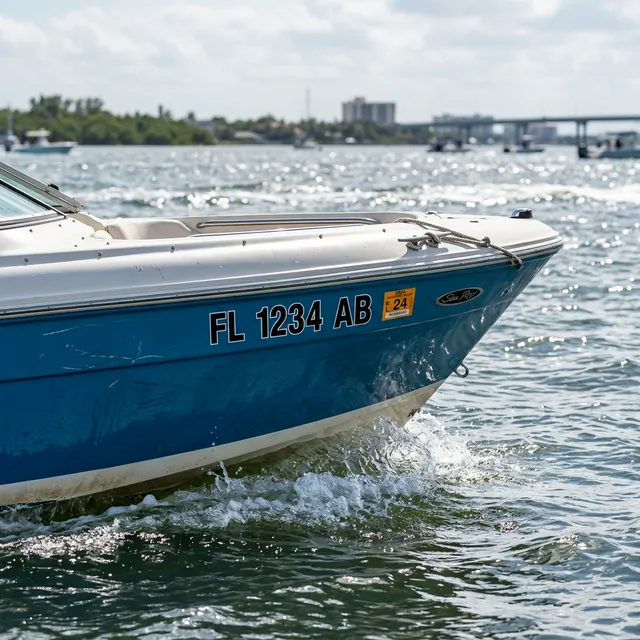
Federal Registration Number Requirements
The display of registration numbers on recreational vessels is governed by federal law under Title 33 of the Code of Federal Regulations (33 CFR 173). These rules establish the baseline display standards for state-numbered vessels, while individual states issue the actual numbers, certificates, and decals.
Every numbered vessel must display its assigned registration number in the required format while operating on covered waters. State agencies also issue validation decals or stickers, but their exact placement instructions vary by state.
| Rule | Baseline answer |
|---|---|
| Character style | Plain block letters and numbers |
| Minimum height | At least 3 inches |
| Hull placement | Forward half of the vessel, on both sides |
| Reading direction | Left to right on each side |
| Color | Contrasting with the hull or background |
| Sticker/decal | Follow the issuing state's placement instructions |
Understanding these requirements is an important part of the boat registration process — your vessel is not legally compliant until the numbers and stickers are correctly displayed.
Number Format
State registration numbers are issued by the state, so display them exactly as shown on your registration card or decals. Do not add extra characters, change the order, or alter the spacing.
If your state uses a space or hyphen in the assigned number, keep that exact layout. The point is consistency between the vessel, the certificate, and the decals so the number is easy to read at a glance.
Avoid decorative graphics or creative spacing near the number. The display should be simple, legible, and identical to the number assigned by your state agency.
Font Size and Style Requirements
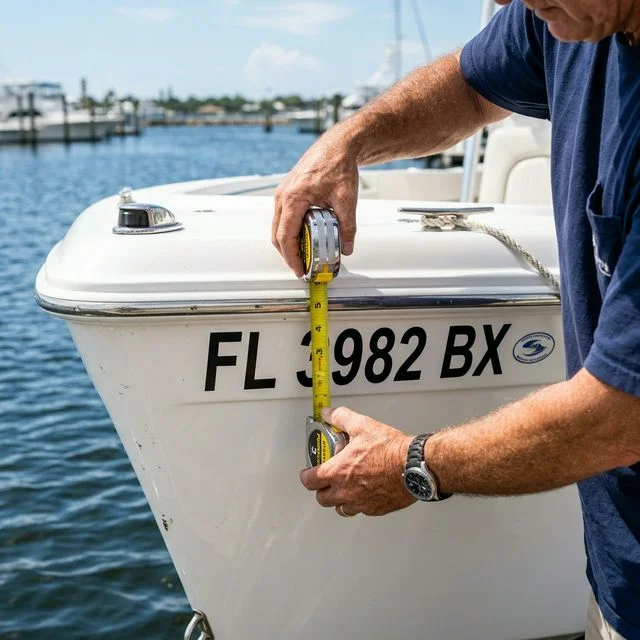
Federal regulations require registration numbers to be displayed in plain block characters of not less than three inches in height. This three-inch minimum applies to all characters in the registration number, including the state prefix letters and suffix letters.
The characters must be of a contrasting color to the hull or background. For example, dark numbers on a light-colored hull or light numbers on a dark hull. The intent is readability from a distance — numbers that cannot be read from a reasonable distance do not meet the requirement, regardless of their technical size.
The font style must be plain, vertical block letters and numerals. Italic, script, serif, shadow, outline, or decorative fonts are not acceptable. The characters should be simple, clear, and easily readable. While no specific font is mandated, sans-serif block letters similar to what you would paint with a stencil are the standard.
Numbers can be painted directly on the hull, applied as vinyl decals, or mounted as raised characters. The method does not matter as long as the size, color contrast, and style requirements are met. Vinyl decals are the most popular option for recreational vessels because they are easy to apply, reasonably durable, and can be cleanly removed if reregistered in another state.
Placement Rules
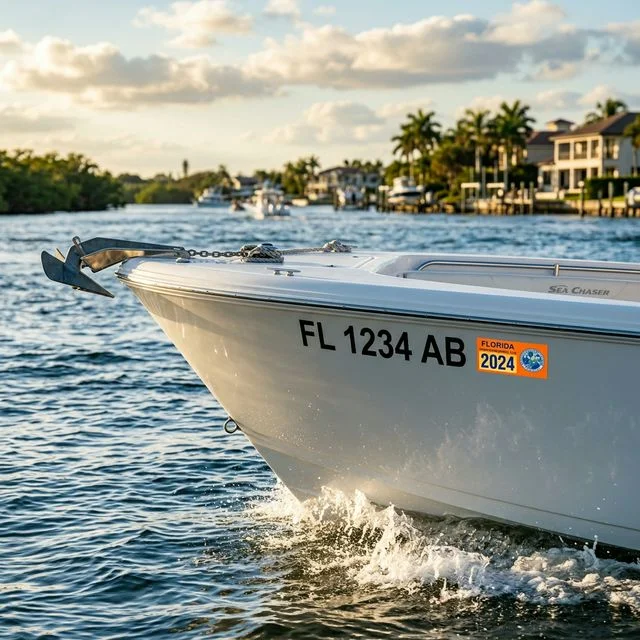
Registration numbers must be displayed on the forward half of the vessel, on both the port (left) and starboard (right) sides. The numbers should be placed as far forward as is practical, typically on the bow area of the vessel.
The number must read from left to right on both sides of the vessel. Unlike some decorative graphics that may mirror, registration numbers must always be oriented so that a person standing in front of the boat can read them correctly on both sides.
Federal rules specify the forward half of the vessel, meaning the numbers should be positioned between the waterline and the deck, on the forward 50 percent of the hull length. Most boaters place numbers on the bow, which comfortably satisfies this requirement.
No other numbers, letters, or characters of similar size or appearance may be displayed on the bow area near the registration number. This prevents confusion between the official registration number and other markings such as the vessel name, racing numbers, or decorative text.
Validation Sticker Placement
In addition to the registration number, most states issue validation stickers (also called decals or tabs) that must be displayed to show current registration status. These stickers serve the same purpose as a license plate sticker on a car — showing that registration fees have been paid and the registration is current.
Sticker placement is controlled by the issuing state's instructions. Many states place the sticker close to the registration number, often near the suffix letters, but you should follow the exact diagram or written instruction that came with your decal.
Some states issue two stickers: one for the starboard side and one for the port side. Other states issue only one sticker for one side, with the other side receiving a simulated or repeated sticker. Always follow your state's specific instructions for sticker placement.
USCG Documented Vessels — Different Rules
Vessels with a valid USCG Certificate of Documentation follow different display requirements. Instead of state registration numbers on the bow, documented vessels display the vessel name and hailing port on the stern (rear) of the vessel. The official documentation number must also be permanently marked on an interior structural member of the hull.
The vessel name on the stern must be displayed in letters at least four inches high in a clearly visible color contrasting with the hull. The hailing port — the port or city and state where the vessel is based — must appear below the vessel name. For full details on documentation, see our USCG documentation guide.
Some states still require a registration credential or decal for documented vessels, so check your state before assuming you are exempt from every state rule.
Common Mistakes and How to Avoid Them
Several common display errors can result in citations. The most frequent mistakes include: using numbers smaller than three inches in height (measure at least one character after application to verify), failing to maintain contrasting color (white numbers on a very light hull, for example), placing numbers too far aft of the bow, not separating the prefix, numerals, and suffix with visible spaces or hyphens, and forgetting to update or display current validation stickers.
Another common issue is faded or illegible numbers. UV exposure, saltwater, and normal wear can cause vinyl decals to deteriorate over time. Inspect your registration numbers at the start of each boating season and replace them if they are no longer clearly readable. Most marine supply stores sell replacement registration number kits in various sizes and colors.
Penalties for Non-Compliance
Penalties for improperly displayed registration numbers vary by state and can include warnings, fines, or an inspection stop.
Improperly displayed or expired registration numbers can also make it easier for law enforcement to stop and inspect your vessel. That can lead to additional citations if other safety issues are found.
Operating without valid numbers, or with numbers from another state without proper authority, can lead to fines and, in some jurisdictions, impoundment.
Frequently Asked Questions
What is the minimum font height for boat registration numbers?
Where do I put registration numbers on my boat?
Can I use any font for my boat numbers?
Where does the validation sticker go?
Do I need registration numbers if my boat is USCG documented?
What color should my boat numbers be?
Can I use a temporary number while waiting for my official registration?
Sources
- Code of Federal Regulations — 33 CFR 173: Numbering of Undocumented Vessels (https://www.ecfr.gov/current/title-33/chapter-I/subchapter-S/part-173)
- U.S. Coast Guard — Vessel Numbering Requirements (https://uscgboating.org/)
- NASBLA — National Association of State Boating Law Administrators (https://www.nasbla.org/)
This information is provided for reference purposes only. While we strive to keep data accurate and up-to-date, registration requirements, fees, and regulations may change without notice. Always contact your state's official registration agency for the most current and authoritative information before making any decisions.