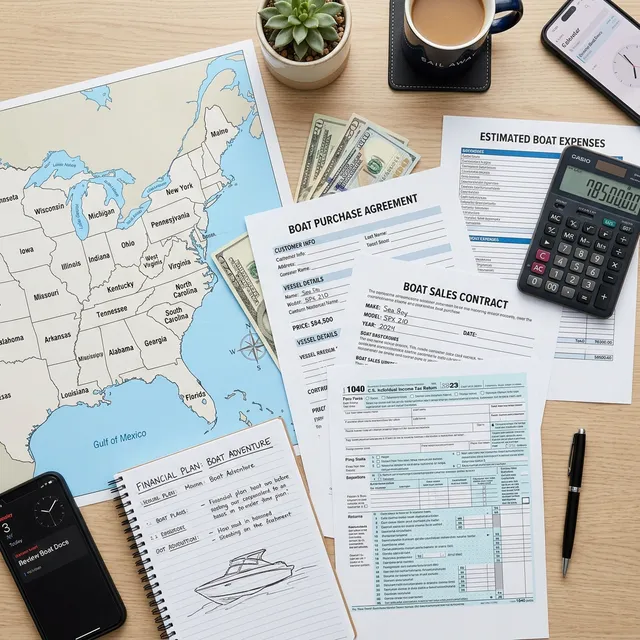
Understanding Boat Sales Tax in the United States
For most boat buyers, sales or use tax is one of the largest costs beyond the purchase price. On a high-value boat, the difference between a state with a cap, a state with no statewide sales tax, and a state with local add-ons can be thousands of dollars.
Boat tax is governed by state and local law, and the result can depend on where the boat is bought, registered, stored, and principally used. Boats are mobile assets, so a purchase in one state can still create a use-tax question in another state.
| Tax question | Practical answer |
|---|---|
| Does the purchase state matter? | Yes, but the registration/use state can still assess use tax. |
| Do zero-sales-tax states solve the problem? | Only if the ownership, registration, and use facts support that treatment. |
| Do boat tax caps matter? | Yes for expensive boats, but only in states and transactions covered by the cap. |
| Does sales tax apply to private sales? | Often collected as use tax during registration, subject to state rules. |
| What document matters most? | A bill of sale or invoice plus proof of any tax already paid. |
This guide explains the main tax patterns, common caps, zero-statewide-sales-tax states, use tax obligations, and legal ways to reduce avoidable tax mistakes.
How Boat Sales Tax Works
When you purchase a boat, whether new from a dealer or used from a private seller, most states require you to pay sales tax on the purchase price. The tax is typically collected at the point of sale by the dealer or at the time of registration if purchased privately.
The tax rate applied is generally the rate of the state where the boat will be registered and primarily used, not necessarily where it was purchased. This is an important distinction that catches many buyers off guard. If you buy a boat in a zero-tax state but register it in your home state that levies sales tax, you will owe use tax (the equivalent of sales tax for out-of-state purchases) to your home state.
Most states apply sales tax to the full purchase price of the boat, including any additional equipment, trailers, and accessories sold as part of the transaction. Trade-in values may be deducted from the taxable purchase price in some states — a significant potential savings for buyers upgrading from an existing vessel.
States with No Sales Tax on Boats
As of this update, five states have no general sales tax, which means boats purchased and registered in those states avoid state sales tax. Those states are Alaska, Delaware, Montana, New Hampshire, and Oregon.
Alaska has no statewide sales tax, though some local governments can levy local sales taxes. Delaware, Montana, New Hampshire, and Oregon do not impose a statewide general sales tax, but buyers should still confirm registration fees, title fees, local rules, and use-tax exposure in the state where the boat will actually be used.
Zero-sales-tax states are only useful when the ownership, registration, storage, and principal-use facts support that treatment. Buying in a no-tax state and then keeping the boat in a taxing state can still create a use-tax obligation.
States with Sales Tax Caps
Several states cap certain boat-related sales, use, or excise taxes. Caps can matter a lot for high-value boats, but each cap has its own scope, forms, and exclusions.
| State example | Common planning point | Important caveat |
|---|---|---|
| Florida | State boat tax is commonly discussed with an $18,000 cap | Local facts, credits, exemptions, and documentation still matter |
| North Carolina | Boat sales/use tax is commonly discussed as 3% with a $1,500 cap | Confirm treatment for trailers, accessories, and transaction type |
| South Carolina | Boat casual-excise-tax treatment can be capped in qualifying transactions | Do not assume every dealer or out-of-state transaction gets the same result |
| Virginia | Watercraft sales and use tax is commonly discussed as 2% with a cap | Verify the current cap and whether your vessel is covered |
A cap does not give you permission to register in a state where the boat is not actually based, stored, or principally used. Use the cap as a planning input, not as a substitute for residency and use-tax compliance.
Use Tax: What Out-of-State Buyers Need to Know
Use tax is the complement to sales tax and can apply when you purchase a boat in one state but use or register it in another state that taxes boat purchases. The use tax calculation often mirrors the destination state's sales tax structure, but credits, caps, exemptions, and local rules can change the final amount.
For example, if you purchase a boat in a state with no sales tax and then bring it to a taxing state for registration or principal use, the taxing state may require use tax unless a credit, exemption, timing rule, or documented nonresident rule applies. Many states credit tax already paid elsewhere, but the receipt and calculation rules vary.
States commonly enforce use tax through the registration process. When you register a boat, you may need to show proof of sales tax payment, pay use tax, or submit an exemption form. High-value vessels can receive closer review.
State-by-State Sales Tax Rates (2026)
Boat sales tax rates can range from no statewide general sales tax to high combined state-and-local rates. A useful comparison should separate four buckets rather than rely on one national number.
| Tax bucket | Examples | Buyer action |
|---|---|---|
| No statewide general sales tax | Alaska, Delaware, Montana, New Hampshire, Oregon | Check local Alaska tax and destination-state use tax |
| Boat-specific cap | Florida, North Carolina, South Carolina, Virginia examples | Confirm cap scope, vessel type, and transaction type |
| State plus local rate | Many states with county, city, or district taxes | Use the exact storage/registration address for estimates |
| Special tax structure | Excise, property, use, or watercraft tax states | Look beyond sales tax before comparing total cost |
For the most current rate in your state, start with your state registration page and confirm the final tax calculation with the state tax agency or registration office before you buy.
The Montana LLC Strategy
One of the most discussed strategies for reducing boat sales tax is forming a limited liability company (LLC) in Montana and titling the boat under the LLC. The tax result depends on the actual ownership, registration, storage, and use facts, not only the state printed on the paperwork.
This strategy carries significant legal and tax risk when the boat is primarily kept or used in another state. Many states assess use tax based on in-state use, storage, residency, or principal-use rules, regardless of where an entity was formed.
If your home or use state determines that the structure does not match the real use of the boat, you could face tax, penalties, interest, registration problems, or audit exposure. Always consult a qualified tax attorney or CPA before using an entity-based strategy.
Legal Ways to Reduce Your Boat Sales Tax
There are several legitimate strategies for minimizing boat sales tax that do not carry the legal risks of questionable LLC structures:
Use any trade-in credit your state allows. Keep receipts for sales tax already paid so you can claim any available credit against use tax. Confirm whether a boat-specific tax cap applies before closing. Separate trailer and accessory paperwork when your state taxes them differently. Document the true purchase price accurately rather than relying on informal side agreements.
If you are buying a boat for commercial use such as charter, fishing for hire, rental, or other business activity, ask the state tax agency whether a commercial exemption or resale certificate applies. Requirements and definitions of commercial use vary by state.
Impact on Your Total Registration Cost
Sales tax is often the most expensive component of the total cost of getting a boat on the water. To estimate your full costs including registration fees and sales tax by state, use our registration fee calculator. For a comprehensive comparison of registration costs across all 50 states, see our state-by-state cost comparison.
Frequently Asked Questions
Which states have no sales tax on boats?
What is the cheapest state to buy a boat for tax purposes?
Do I have to pay sales tax if I buy a boat from a private seller?
Can I avoid sales tax by buying a boat in a different state?
Is the Montana LLC strategy legal for avoiding boat sales tax?
Does sales tax apply to the boat trailer too?
Are there sales tax exemptions for commercial boats?
Sources
- Tax Foundation — State Sales Tax Rates (https://taxfoundation.org/)
- NASBLA — National Association of State Boating Law Administrators (https://www.nasbla.org/)
- Individual state DMV/DNR official fee schedules
This information is provided for reference purposes only. While we strive to keep data accurate and up-to-date, registration requirements, fees, and regulations may change without notice. Always contact your state's official registration agency for the most current and authoritative information before making any decisions.