Do You Need Boat Insurance?
Unlike auto insurance, boat insurance is not a universal state-law requirement in the United States. The practical answer depends on four things: the state where you operate, whether the boat is financed, where it is stored or docked, and how much liability or hull-damage risk you can afford to carry yourself.
| Situation | Insurance answer | What to check |
|---|---|---|
| Arkansas covered vessel | Liability insurance required for motorboats over 50 HP and personal watercraft | Minimum liability amount and proof-on-board rule |
| Utah covered vessel | Liability insurance required for covered motorboats and PWC | Under-50-HP motorboat and airboat exemptions |
| Financed boat | Usually required by the lender | Loss payee, hull coverage, deductible, and navigation limits |
| Marina slip or storage | Often required by contract | Liability limit and additional-insured wording |
| Paid-off boat in most states | May be optional by law, but still a risk decision | Liability, theft, storm, towing, and trailer exposure |
Understanding when insurance is required and what it covers will help you make informed decisions about protecting your investment and your financial security. This guide covers state requirements, lender and marina mandates, coverage types, and cost-saving strategies.
State Insurance Requirements
A small number of states require liability insurance for certain vessels. As of this update, Arkansas and Utah are the clearest examples.
Arkansas requires liability insurance for motorboats powered by engines of more than 50 horsepower and for personal watercraft. The minimum required liability coverage is $50,000 per occurrence, and proof of insurance must be carried on board for covered vessels.
Utah requires the owner or operator to carry liability insurance for covered motorboats and personal watercraft. Motorboats with engines under 50 horsepower and airboats are exempt, but proof of insurance must still be carried on board for covered vessels.
Most states still leave the decision to boat owners, but lenders and marinas often impose their own coverage rules even where state law does not.
That said, the absence of a state mandate does not mean you should skip insurance. A serious boating accident can involve medical bills, property damage, cleanup costs, towing, and legal defense that exceed the value of the boat itself.
Lender Requirements
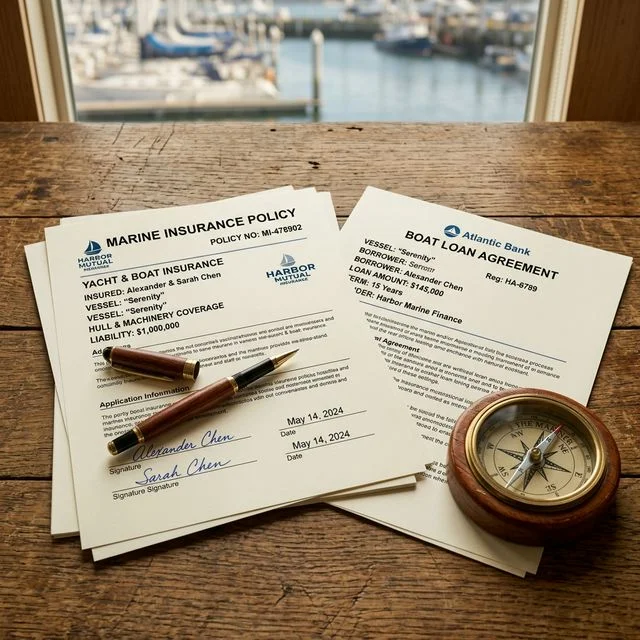
If you finance your boat through a bank, credit union, or marine lender, insurance is typically required as a condition of the loan. The lender may require hull coverage, liability coverage, a maximum deductible, navigation limits, and lender listing as loss payee or additional insured.
Insurance requirements for financed boats commonly include agreed-value or replacement-value language, continuous coverage for the entire loan duration, and prompt notification to the lender if the policy is canceled or lapses.
Allowing your insurance to lapse on a financed boat can trigger serious consequences, including the lender purchasing force-placed insurance on your behalf (which is significantly more expensive) or declaring a default on the loan.
Marina and Launch Requirements
Many marinas, yacht clubs, boat storage facilities, and public launch ramps require proof of insurance as a condition of use. Marina requirements are common in coastal areas and on popular inland lakes across the country.
Marina contracts often specify a liability limit and may require the marina to be named as an additional insured. If you plan to dock at a marina, verify insurance requirements before signing a slip agreement because changing coverage after the fact can be expensive and time-consuming.
Types of Boat Insurance Coverage
Boat insurance policies typically offer several types of coverage that can be combined to create a comprehensive protection package. Understanding each type helps you choose appropriate coverage without overpaying.
Liability Coverage
Liability insurance covers damage you cause to other people or their property while boating. This is the most critical type of coverage because boating accidents can involve injuries, deaths, property damage, environmental cleanup, and legal defense. Choose a limit that matches your boat, waters, passengers, and assets at risk.
Collision Coverage
Collision coverage pays for damage to your own boat resulting from collisions with other vessels, objects, or submerged hazards. The payout is based on either agreed-upon value (the stated value of the boat at the time the policy is written) or actual cash value (depreciated value at the time of loss). Agreed-upon value policies usually provide more predictable payouts.
Comprehensive Coverage
Comprehensive coverage protects against non-collision losses such as theft, fire, vandalism, storm damage, and sinking. This coverage is particularly important for boats stored outdoors or in hurricane-prone areas. Most financed boats require both collision and comprehensive coverage.
Uninsured Boater Coverage
Similar to uninsured motorist coverage for automobiles, this protects you if you are injured by an uninsured or underinsured boater. Given that boat insurance is not mandatory in most states, the risk of encountering an uninsured operator is significantly higher than on the road.
Additional Coverage Options
Other coverage options that may be valuable include: towing and assistance (on-water towing, similar to roadside assistance), personal effects coverage (for gear, electronics, and fishing equipment on board), trailer coverage (for the boat trailer during transport and storage), environmental damage liability (for fuel spill cleanup and related environmental costs), and medical payments coverage (covers medical expenses for you and your passengers regardless of fault).
How Much Does Boat Insurance Cost?
Boat insurance cost is quote-specific. A small inland fishing boat, a financed wake boat, and an offshore center console can produce very different premiums even when registered in the same state.
Factors that affect your premium include the type and value of the boat, horsepower and speed, boating area, storm exposure, claims history, coverage limits, deductible, storage method, trailer coverage, and whether the operator has completed an approved boater safety course.
For planning, compare at least one marine-specialty quote and one bundle quote from a carrier that already insures your home or vehicle. Make sure the quote uses the same navigation area, deductible, hull value, and liability limit before comparing price.
Premium Trends in 2025-2026
Boat insurance premiums can change quickly because insurers adjust for repair costs, storm exposure, theft, claims experience, and the local marina or storage environment. Coastal and hurricane-exposed markets may be quoted differently from inland freshwater markets.
To offset rising premiums, consider increasing your deductible (which reduces your premium), bundling boat insurance with your homeowner's or auto policy, completing an approved boater safety course, and installing anti-theft and safety equipment such as GPS trackers, automatic fire suppression systems, and carbon monoxide detectors.
Tips for Choosing the Right Policy
Not all boat insurance policies are created equal. When shopping for coverage, pay attention to agreed-upon value vs. actual cash value (agreed value is generally better for boat owners), navigation limits (some policies restrict how far from shore or which waterways you can operate), lay-up periods (reduced coverage during months the boat is not in use, which can lower your premium), and whether the policy covers consequential damage from mechanical failure.
Always obtain quotes from more than one insurer, including at least one marine specialty option if the boat is valuable, financed, used offshore, or stored in a higher-risk area. Compare exclusions as closely as price.
For more information on the overall boat registration and ownership process, visit our step-by-step registration guide.
Frequently Asked Questions
Is boat insurance legally required?
How much does boat insurance cost per year?
Does my homeowner's insurance cover my boat?
What is the difference between agreed value and actual cash value?
Can I get a discount on boat insurance for completing a safety course?
Does boat insurance cover my trailer?
Do jet skis and PWCs need separate insurance?
Sources
- National Association of Insurance Commissioners — NAIC (https://www.naic.org/)
- BoatUS — Boat Insurance Guide (https://www.boatus.com/)
- U.S. Coast Guard — 2024 Recreational Boating Statistics (https://uscgboating.org/statistics/)
- NASBLA — State Boating Law Summary (https://www.nasbla.org/)
- Arkansas Department of Finance and Administration — Motor Boat Registration (https://www.dfa.arkansas.gov/office/motor-vehicle/motor-boat-registration/)
- Utah Outdoor Recreation — Boating Registration & Insurance (https://recreation.utah.gov/boating-overview-original/rules-and-regulations/boating-registration-and-insurance/)
This information is provided for reference purposes only. While we strive to keep data accurate and up-to-date, registration requirements, fees, and regulations may change without notice. Always contact your state's official registration agency for the most current and authoritative information before making any decisions.