Why Boater Education Matters
Boating safety education saves lives. According to the US Coast Guard's annual Recreational Boating Statistics report, operator inexperience and lack of safety education are consistently among the top contributing factors in boating accidents. States with mandatory boater education requirements have seen measurable reductions in boating fatalities and injuries over the past two decades.
Beyond safety, boater education is increasingly a legal requirement. As of 2026, the vast majority of US states have enacted some form of mandatory boater education for at least a segment of their boating population. Failing to meet your state's requirements can result in fines, citations, and even the inability to operate your vessel legally on public waterways.
Whether you are a first-time boat owner or an experienced captain, understanding your state's boater education requirements is an essential part of the boat registration process.
Types of State Education Requirements
States vary significantly in how they structure boater education mandates. Requirements generally fall into four categories, each with different implications for who must complete a safety course.
Category 1: Mandatory for All Operators
The most comprehensive approach requires all boat operators to complete an approved boater safety course, regardless of age or experience. States in this category include Alabama, California (fully mandatory as of January 1, 2025), Connecticut, Delaware, and Oregon among others. In these states, every person operating a motorized vessel must carry a boating safety education certificate or card at all times while on the water.
Category 2: Mandatory Based on Birth Date
Several states have implemented phased requirements where the mandate applies to boaters born on or after a specific date. Florida is a well-known example: anyone born on or after January 1, 1988, must complete a boater safety course to operate a motorized vessel with 10 or more horsepower. Over time, this approach eventually requires all operators to hold education certificates as older, exempt boaters retire from the waterways.
Category 3: Mandatory Based on Age
Some states require boater education only for operators below a certain age. For example, a state may require anyone under 16 or under 18 to complete a safety course before operating a motorized vessel. Older operators in these states are not required to hold a certificate, though taking a course is always recommended. States like Michigan and Minnesota use variations of this age-based approach.
Category 4: No Mandatory Requirement
A small number of states currently have no mandatory boater education requirement for any age group. However, even in these states, completing a voluntary safety course can qualify operators for insurance discounts and is strongly recommended by every major boating organization. The trend is clearly toward universal mandatory education, so states without current requirements may adopt them in the future.
What Does a Boater Safety Course Cover?
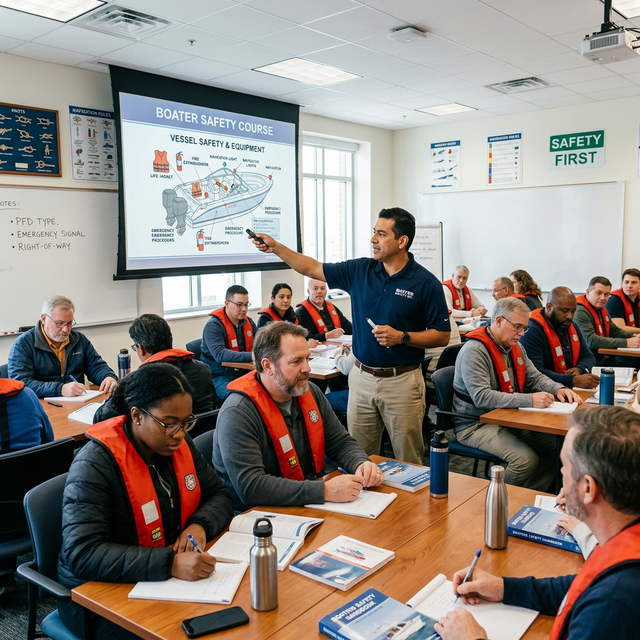
Approved boater safety courses follow a curriculum standard set by the National Association of State Boating Law Administrators (NASBLA). A typical course covers the following topics in 6 to 8 hours of instruction:
Navigation rules and right-of-way on the water. Required safety equipment including life jackets (PFDs), fire extinguishers, visual distress signals, and sound-producing devices. Safe boating practices including speed management, weather awareness, and passenger safety. State-specific boating laws and regulations. Alcohol and drug awareness while boating. Trailering and launching procedures. Emergency procedures including man-overboard recovery, capsizing, and calling for help. Environmental responsibility and clean boating practices.
Upon successful completion, participants receive a boating safety education certificate (sometimes called a boating license or boater card) that is valid for life in most states. Some states require a separate state-specific exam after completing the general course.
NASBLA-Approved Courses
The National Association of State Boating Law Administrators (NASBLA) sets the standard for boater education nationwide. A NASBLA-approved course meets the minimum educational requirements for boating safety and is recognized by the US Coast Guard and almost all state boating agencies.
Popular NASBLA-approved course providers include: the BoatUS Foundation (free online course), Boat-Ed.com (state-specific courses, typically $29.95), BOATsmart! (interactive online course), and various state agency direct courses (some states operate their own free courses). When selecting a course, verify that it is approved by your specific state. While NASBLA approval is widely accepted, some states have additional requirements or may only accept courses from specific providers.
Online vs. In-Person Courses
Boater safety courses are available in both online and in-person (classroom) formats. Each has advantages depending on your learning style and schedule.
Online courses offer flexibility to study at your own pace, complete sections over multiple sessions, and take the final exam when you feel ready. Most online courses cost between $0 and $35 and can be completed in 4 to 8 hours. The BoatUS Foundation course is completely free and NASBLA-approved, making it an excellent option for budget-conscious boaters.
In-person courses, often offered by state wildlife agencies, the US Coast Guard Auxiliary, or the US Power Squadrons, provide hands-on instruction and the opportunity to ask questions in real time. These courses are sometimes available free of charge, though availability varies by location and season. Weekend courses and evening multi-session formats are common.
State-by-State Comparison of Key Requirements
Requirements vary widely across the country, and specific rules can change from year to year. Here is a summary of key patterns across the 50 states. For the most current details for your state, visit your state's registration page which includes specific education requirements.
States with the most comprehensive requirements (mandatory for all operators) include Alabama, California, Connecticut, Delaware, Illinois, Iowa, Kansas, Maryland, Massachusetts, Michigan, Minnesota, Missouri, Montana, Nevada, New Hampshire, New Jersey, New Mexico, New York, North Carolina, Ohio, Oklahoma, Oregon, Pennsylvania, Rhode Island, Tennessee, Texas, Utah, Virginia, Washington, and West Virginia.
States using a phased birth-date approach include Florida (born on/after 1/1/1988), Georgia (born on/after 1/1/1998), South Carolina (born on/after 6/30/1988), and several others with varying cutoff dates.
The remaining states use age-based requirements or have no mandatory requirement at all. Regardless of your state's mandate, every boating organization recommends completing a safety course before operating any vessel.
Recent Changes and Trends (2024-2026)
The boater education landscape continues to evolve. California completed its phased-in mandatory education requirement on January 1, 2025, now requiring all operators of motorized vessels of 15 horsepower or more to hold a California Boater Card (a one-time $10 fee for lifetime validity). The requirement was phased in by age starting in 2018, and the final phase included all remaining operators regardless of age. Minnesota is implementing a similar phased approach through 2028, gradually lowering the birth-date threshold each year until all operators need education.
Several states have also been expanding the types of vessels that trigger education requirements. Jet ski (PWC) operation increasingly requires separate certification in some states, and a few states have begun requiring education for operators of high-powered electric boats, recognizing that emission-free does not mean risk-free.
These trends suggest that within the next decade, nearly all US states will have some form of universal boater education requirement. Taking a course now — even if not required — positions you ahead of future mandates and makes you a safer operator.
Exemptions and Reciprocity
Most states offer exemptions from boater education for specific groups. Common exemptions include: US Coast Guard licensed captains, active-duty and retired military members with boating-related training, commercial fishing license holders, rental boat operators on guided trips (rental companies often provide basic instruction), and visitors holding valid boater education certificates from other states.
Boater education reciprocity varies by state. Most states recognize NASBLA-approved certificates from other states, but not all. Before operating in a new state, verify whether your existing certificate is accepted. The NASBLA website maintains a reciprocity matrix showing which states accept which certifications.
Frequently Asked Questions
Is a boating safety course the same as a boating license?
How much does a boater safety course cost?
Does the boater education certificate expire?
Can I use an out-of-state boating certificate?
What happens if I am caught without a boating certificate in a mandatory state?
Are there any benefits to taking a course even if my state does not require one?
Sources
- NASBLA — National Association of State Boating Law Administrators (https://www.nasbla.org/)
- U.S. Coast Guard — 2024 Recreational Boating Statistics (https://uscgboating.org/statistics/)
- BoatUS Foundation — Free Online Boating Safety Course (https://www.boatus.org/)
This information is provided for reference purposes only. While we strive to keep data accurate and up-to-date, registration requirements, fees, and regulations may change without notice. Always contact your state's official registration agency for the most current and authoritative information before making any decisions.